RobboNet
Hue City: A Map Design Case Study In Rising Storm 2
While most of my time is spent learning how to program the games I wish existed, I also spend a lot of time thinking about the extant games I love and what it is about them that I admire. Most of these thoughts stay in my head, or are forced upon my poor disinterested friends, but after the KSP Companion I wanted to do something a bit different, and so I started to put into words some of my thoughts about one of my favourite FPS maps: Rising Storm 2's Hue City.
The resulting essay is in my thorough and analytical style, and touches upon not just the design of the map itself, but also related contextual details such as where Rising Storm 2 sits in the ever evolving FPS tradition, and how we might design maps for these games in the future. I will summarise the main arguments and copy the conclusion out verbatim. If you feel tempted to read the whole essay, you may find it at the bottom of the page.
Introduction
In Rising Storm 2, the map Hue City is an absolute blast. The fighting is incredibly intense for both attackers and defenders, and when the game was first released, players would often vote to play in Hue at every possible opportunity. I believe that the reason for this popularity lies in the interaction between the design of the map and the design of the game itself.
The Impact Of A Shooter's Time-To-Kill
Rising Storm 2 differs from most other first-person shooters in that it attempts to simulate realistic bullet damage, often resulting in players being killed by a single hit. This puts the game at the extreme low-end of the time-to-kill (TTK) spectrum of shooter games, which classifies games according to how much time it takes, on average, for a player to kill another player. The TTK of a shooter often leads to many of the characteristic features of the game. For example, the huge TTK of games such as Overwatch and Team Fortress 2 enable those games to offer their extremely diverse character sets, as engagements in low TTK shooters are often very sensitive to differences between the combatants' health, armour, or weaponry. Another distinctive example is the high TTK Halo, where skilled players make use of teamshotting and weaponcomboing to maximise their opponents TTK while minimising their own.
What is important to Rising Storm 2 is that as TTK decreases, the relative strength of defenders against attackers increases. With a high TTK, a player under fire has time to reposition to the next piece of cover. Several attackers moving together may simply have too much health for their traversal to be blocked. With a low TTK, even a single well positioned defender can block the movement of many attackers at once. Thus, matches in Rising Storm 2 often break down into a sequences of chokepoint engagements, with the progress of attackers occurring as checkpoints towards their objective.
Hue City's Chokepoint Network
This is why Hue City is such a successful map: it offers a sequence of well-designed chokepoints, that are simple for the defenders to establish and interesting for the attackers to assault. The simplicity is important because, unfortunately, there is often a lack of communication within teams in Rising Storm 2. Inability to establish chokepoints is a frequent fatal failure by defending teams in Rising Storm 2, so games are often too brutal for the defenders and too short and easy for the attackers. Once the map meets the basic combat expectations of the players, it then offers attackers a diverse and interesting set of choices to their approach. To show this more easily, I came up with a diagrammatic way of displaying the network of chokepoints. Using these visual elements we can examine the chokepoint network of a section of Hue City in greater detail:
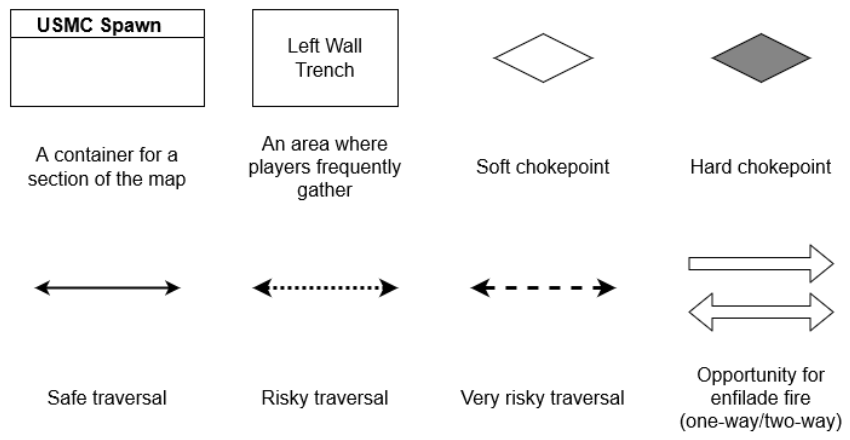
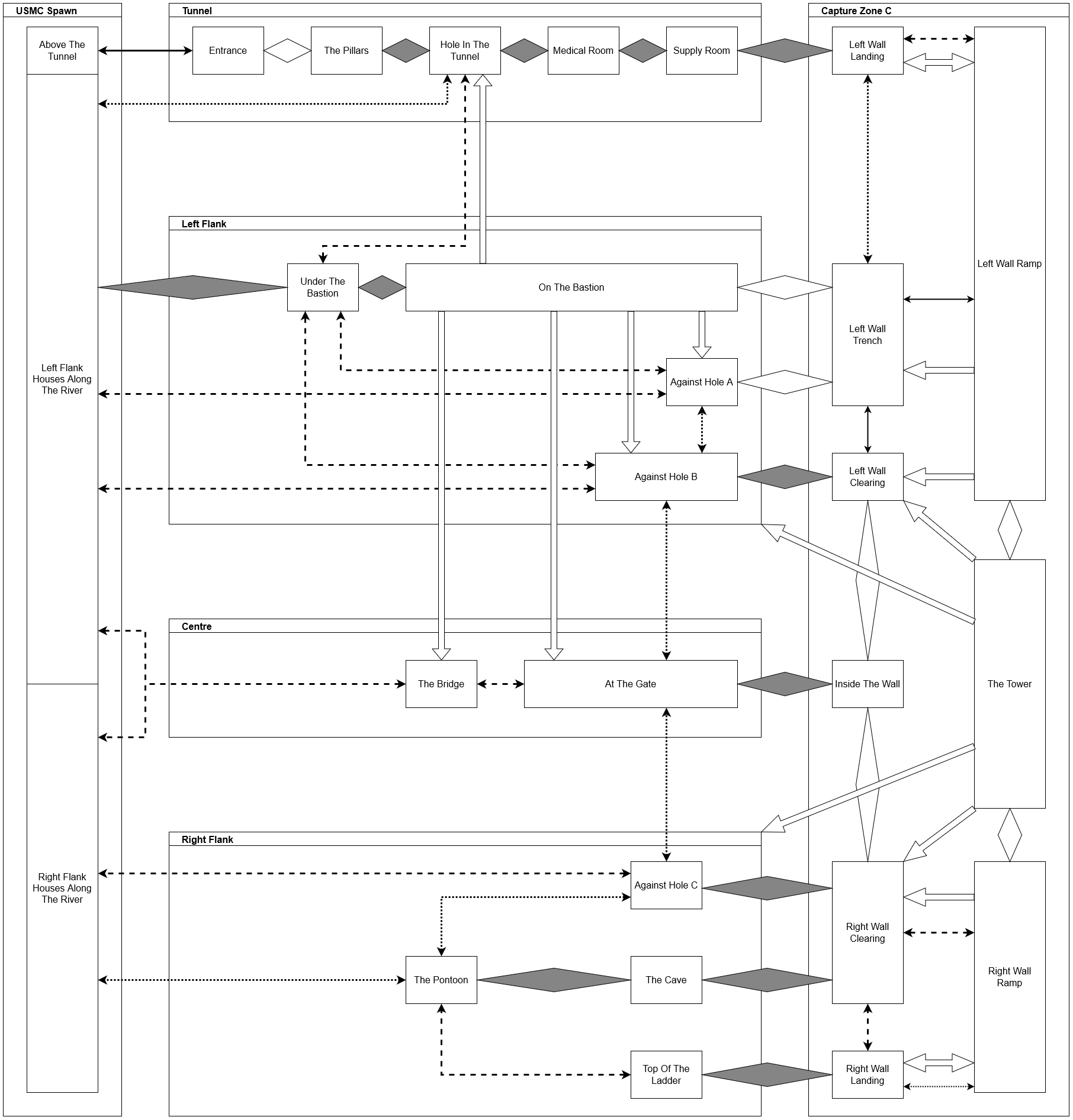
This diagram represents the attackers' approach to capture zone C on Hue City. First of all, when we examine the capture zone itself we see that it's simple for defenders to establish a firm basic resistance. There are only 8 chokepoints into the capture zone, and with teams of 32 these chokepoints are usually swiftly occupied. From there, we break the approach down into four sections. This is helpful because combat in each of the sections is largely independent, and because the combat in each section has its own character. Studying the sections in isolation reveals the interesting choices that attackers have during their approach to the capture zone.
The left and right flanks are the main avenues for the assault. There's lots of space and potential throughput of attackers, and several ways into the capture zone. The left flank features a large bastion wall, from which defenders can fire upon attackers in nearby sections. This makes the left flank an important target for the attackers, as disrupting the bastion can help allies across the map. The right flank gives attackers safer routes to the centre and beyond. Breakthroughs from these flanks are massively disruptive to the defenders, and can lead to the capture zone falling.
The centre and the tunnel are a bit different. The centre is the most direct route into the capture zone, but it's risky as the approach is very exposed. Instead, players will often advance up the right flank and move into the centre from there. This redistributes some potentially redundant attackers to sections of the defence that might be softer. The tunnel has a simple linear sequence of chokepoints. Progress in the tunnel is usually costly but very stable, and pressure from the tunnel typically builds over time to undermine the long term stability of the defence. However, the total throughput of soldiers is low. Breakthroughs from the centre or the tunnel rarely lead to a capture on their own, but instead they can boost the momentum of breakthroughs in the flanks.
In summary, this capture zone is simple to defend and interesting to attack. There's a diversity in how attackers want to conduct their assault, and players can expect their experience to change from game to game. This is true for the other capture zones throughout the map. It makes for some memorable experiences and keeps players hungry for more.
What We Can Learn From Hue City
So what can we take forward from the design of Hue City?
First of all, Hue City succeeds because the high-level strategic choices for players are interesting. Within a single capture zone, there can be a variety of experiences. Throughout a map, the capture zones themselves can offer a variety of experiences as well.
Secondly, on a small scale Hue City delivers those experiences with precision. There's no careless placement of obstacles, cover, or chokepoints. Strategically important elements such as capture zones and ammo boxes are well placed as well. Even small changes to these elements can have big impacts, and I believe many other maps in the game feature capture zones whose boundaries are exploited by experienced players.
Finally, the popularity of Hue City is the result of the design of Rising Storm 2 itself. Whereas the previous points are specifically about map design, this point is more about how the rest of the game's design can empower map designers to have greater freedom and creativity. Hue City's uniquely extreme expression of urban combat makes it easy for emergent teamplay to occur, even in the context of Rising Storm 2's largely uncoordinated teams. Along with a lack of communication, there is generally a lack of coordination within the 6 man squads that every player is nominally a part of. Rather than act as units under the direction of the team leader, players in squads often play independently.
Several FPS games have made innovative changes however, and adopting them could then enable map designers to ask more complex strategic questions of teams. For example, Overwatch has its 'kudos' system to promote sporting behaviour. It also allows players to queue for particular roles within the team, allowing the empowered matchmaking system to more reliably deliver the embryo of a cohesive team. Squad and Hell Let Loose feature the milestone innovation of having a separate chat channel for the team leader and their squad leaders. Finally, Verdun and Post Scriptum wisely predefine what type of soldiers make up each squad, solving the common issue in Rising Storm 2 of squads either being a mix of uncomplementary specialised weaponry or squads being almost exclusively riflemen with little specialised support.
Conclusion (Verbatim)
Rising Storm 2's idiosyncratic damage mechanics, inherited from its ancestor Red Orchestra, bring unique challenges to the task of map design. The ability for defenders to establish strong killzones from well protected positions makes them far more powerful than in other first-person shooters, and just a few veteran players may prove to be an insurmountable obstacle to the inexperienced. Many of the game's maps struggle to reliably create a lasting combat experience that satisfies both teams, and it is in this environment that Hue City achieves unparalleled yet controversial popularity. Understanding why Hue City proved so popular can help designers create better maps and even better games for us to enjoy.
What we have seen is that Hue City is a map that makes it easy for defenders to establish firm resistance. Once that base for the experience is in place, it then offers attackers interesting options for assaulting that defence. Progress to the attackers can occur in diverse ways, with some paths offering costly major breakthroughs while others undermine the long term stability of the defenders. The narrowness of the design makes the map a uniquely extreme expression of close-quarters combat, and, in the context of Rising Storm 2's uncoordinated teams, that makes it simple for teamwork to occur even from teams of silent individuals. The result is a map that provides an engrossing combat experience, full of memorable encounters in a diverse variety of forms.
While Red Orchestra was once the choice of a niche corner of the gaming community, it has since inspired an increasing number of new releases with growing financial backing. As Red Orchestra's descendants continue to grow in popularity, the designers in this realm will benefit from exemplary successes like Hue City as they push this blossoming corner of the otherwise ripened shooter world to its full potential. While it is not clear how much growth is still possible, I personally hope that one day a critical mass of popular appeal will be reached, such that a studio feels ready to launch a refined esports experience for this subgenre. This has already happened for games across the rest of the TTK spectrum, with unprecedented returns. If that lucrative milestone can be reached, I hope that the memory of Hue City and the other popular maps of today will live on through the competitive arenas of the future.